
The Offending Brownie « TinyPants — tiny pants. big ideas.
March 13, 2011 § Leave a comment
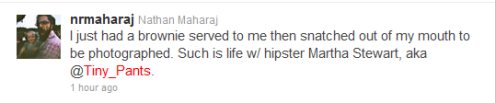
I made Smitten Kitchen’s White and Dark Hearted Brownies tonight. Hubby was less than pleased. Oh, what it must be like to be married to a blogger.
I, on the other hand, was quite pleased with my first foray into the brownie world. (Honestly! I’ve never even made them out of the box!) The “offending” brownies are quite delicious, and as I suspected the blondies are right up my not-so-into-chocolate alley.


The wrong approach to publicity for Kathryn Schulz, aka. @wrongologist?
March 6, 2011 § Leave a comment
Something @CharlieSheen and I have in common
March 3, 2011 § Leave a comment
In the mid-90s, I starred as the relentless sheriff in “That Darn Priest”, a biting satirical look at Graham Greene’s classic novel The Power and the Glory, the story of a catholic priest on the run from the law in fascist Mexico. An instant high school cult classic, “That Darn Priest” spawned the catch phrase “¡oy oy oy! ¡Mi testiclos!” and earned me a failing grade on that particular assignment in my grade 12 English class.
And Charlie Sheen recently starred in this: http://goo.gl/X4OiN
Bookstores need more money, less mouth
February 24, 2011 § Leave a comment

Wolfgang Books. Phoenixville, PA.
The bookstore I co-founded and built from the acquisition of a single rare book is closing at the end of March. Wolfgang Books has been a mainstay of the Philadelphia area for the last five years. It has won four consecutive “Philadelphia Hot List – Best of Philly” awards and has never been shy of good press. Any walk of bibliophile can find something at Wolgang’s. Rare, used and plenty of new titles are to be had. Of the new titles I’d say 80% are from indie publishers and 100% are chosen by the bookseller.
That’s a lot of talk. Since my former business partner, Jason Hafer, to whom I sold my half of the company, announced that he was going to close the store because of slowed sales (and they are slow) I have heard a lot more talk. No doubt he’s heard still yet more.
“Was there no way to save it?”
“Are e-books killing bookstores?”
“I thought with Borders retreating it might get better for indies.”
“I always mean to go in but forget to.”
“These are hard times.”
“Amazon, Amazon, Amazon…”Someone recently told me that they love the store and wished they had bought more books there — but Amazon, they said, was just too cheap. Not in the mood to accept their expiation I decided to tell them that the situation they just described was a major reason for the store’s closing. They acknowledged my point and proceeded to ask me if I knew whether the rare & collectible books were going to be on sale. Apparently paying full-price on front list paperbacks was too much of a hardship for him. Getting 40% off on a first edition of Celine, well, that right there fit snugly into the budget. Hell and damnation.
The other day I read a pair of articles about Borders “retreat” and found the same sentiments on display.
Tim Feran in the Columbus Dispatch writes:
Book-loving bargain hunters last weekend jammed the Columbus Borders locations slated to close as part of the company’s bankruptcy filing.
Parking lots at the two stores, at 4545 Kenny Rd and 6670 Sawmill Rd., were so crowded at times that would-be shoppers couldn’t find a space, several people said.
“I tried to stop by a few times Saturday, but there was no parking,” said Marie Gherghei of Columbus, who visited the store on Kenny Road. “My boyfriend and I finally were able to find parking Sunday. The store was packed full of shoppers.”
Later Feran describes the frustrations of one of the bargain-hunters:
“Most everything I looked at — books and DVDs — was 20 percent off,” said Gary Daniels of Columbus. “That’s still significantly more than I want to pay when I can get much better deals on Amazon Marketplace, eBay and at Half Price Books without waiting in line.”
The blood in the water was apparently enough of an attraction, but seeing prey that was only moribund was not enough to get a bite. I don’t blame Gary Daniels for not buying a DVD for 20% off because he showed up hoping for some far greater savings. I am curious about the packed parking lot and circling cars. I am doubly amazed that people couldn’t find parking and had to (and did) try again on another day. Most of all I wonder about a store packed to the gills in late February, a murderous retail month, that was formerly so devoid of customers that it was … closing.
Apparently the readers are there. Apparently their credit cards are not as yet still red hot from the recent holiday season. These are readers, I should add, of the physical book. I mean, this wasn’t a Sears closing and people weren’t climbing over themselves to get a microwave, washer & dryer or much-needed replacement for an ancient refrigerator. These were books.
Indie bookstores pride themselves on their ability to champion things. The other article I recently read was by an Australian bookseller who observed that Australian writing is not generally well-represented throughout the publishing world and that an indie Australian store is one of the few places sensitive to that situation. Granted, indies can sometimes be prone to translating their sensitivities into a “tin cup” strategy of feeling entitled to customers that they may not always be competitively wooing.
After readings about a bustling Borders and being asked about discounts on rare books I’m prepared to give it all (economy, e-books, Amazon) a pass in my mind. Instead I think some realizations need to be made about how and where we’re spending our book-buying money. Sincere guilt at passing on your beloved bookstore is a start.
It will not however keep the lights on and the shelves stocked. Just so you know.
So let’s sum up: Paul Oliver’s bookstore would have fared better if customers felt guilty about not shopping there; what’s on the shelves should be good enough for the customers because 100% of it was selected by the bookseller; and customers should be berated for buying identical goods from someone else at a lower price.
If his aim was to mitigate the pain of his store’s closing, he’s right on target.

Because he was bad.
February 13, 2011 § Leave a comment
Noticing this weekend that the prevailing rhetoric in vaguely liberal circles around the ousting of Hosni Mubarak seems to pretty neatly parallel how conservatives talked about toppling Saddam Hussein.
The ideological formulation goes something like this:- That guy is bad!
- The people don't like him!
- Uh… er… freedom!
The armchair scholars add:
- Isn't it crazy how our government used to like this guy? [insert picture of diplomat from your country shaking hand of demonic despot]
And in case you start to lose your focus, remember:
- Anyone who talks about power vacuums and regional instability is a tyrant-lover.

 Nathan's blog